March for Accessibility: First page >  In English
In English- Förstasidan
- In English|
 Lättläst|
- Marschen 2012|
- Nyheter|
- Vanliga frågor|
- Vi stödjer marschen|
- Stöd oss!|
- Nuvarande lagstiftning|
- Så ser det ut|
- Anmäl otillgängligheten|
- Dokument|
- Press och media|
- Arkiv - tidigare års marscher|
- Kontakt - om oss|
- Forum|
Logga in:
In English
INACCESSIBILITY IS DISCRIMINATION!The March for Accessibilty (Marschen för tillgänglighet in Swedish) was an organization aimed at enacting a law classifying inaccessibility as discrimination of people with disabilities in Sweden.
From 2003 to 2012 ten demonstrations with the same name as the organisation was held annually nationwide in Sweden.
Here you can take part of how the English site looked until the last demonstration 2012. If you want more information, please go to the first page in Swedish and use a translation service such as Google translate.
The March for Accessibility 2012
The March for Accessibility 2012 (the demonstration) will be held on Saturday May 26th.
Participating cities are: Boden, Borlänge, Göteborg, Halmstad, Helsingborg, Jönköping, Karlskrona, Karlstad, Kristianstad, Kumla, Linköping, Malmö, Ronneby, Skellefteå, Stockholm, Strömsund, Uppsala, Varberg, Västerås, Växjö och Örnsköldsvik. (List last updated: 2012-05-25.)
There is extensive information in Swedish about each march which will not be translated into English or any other language. But we will gladly answer any question or inquiry you have! Please write info@marschen.se.
Participation information for Stockholm
Times: Gathering 13.00 (1 pm), marching time 14.00 (2 pm), the march takes about 45 minutes
Starting point: Humlegården (To find it, look at the map with Humlegården at maps.google.se. Use the function "Vägbeskrivning" to get directions from any place in Sweden.)
Goal: Sergels torg
Here you can find a brief FAQ about The March for Accessibility. There is a more extensive FAQ in Swedish att www.marschen.se/vanligafragor which can be translated using online translation services. If you have questions which aren't answered here, don't hesitate to mail them to us at info@marschen.se and they will be answered as soon as possible.
1. What is the background of the march?
2. Why is a law that defines inaccessability as discrimination necessary?
3. What is The March for Accesibility?
4. Who support us?
5. What can I do to help?
1. What is the background of the march?
The background of the march lies in the American disability advocacy group ADAPT's "Free Our People March" in 2003, an event aimed at enacting the MiCASSA - an equivalent of the Swedish laws granting people with disabilities the right to attendant cares. Compared to Sweden, the US does not lack an anti-discrimination law (ADA (Americans with Disabilities Act)).
Links:
www.adapt.org - about ADAPT and their work toward enacting the MiCASSA
Tillbaka.
2. Why is a law that defines inaccessability as discrimination necessary?
Theoretically, everyone agrees on a society accessible for everybody, but there is a giant gap between intention and reality. Media and public opinion, as well as politicians and other policymakers, have to be made conscious of the seriousness of the situation in Sweden. Everyone must be able to cross a street or to visit websites, to go see a movie or eat out with his/her spouse, children, parents, friend and so on - in short: everyone must be able to live their lives just like everybody else, no matter if they have a disability or not.
In Sweden, there is already strong legislature intended to make society accessible. The problem is that the present laws are not followed. Some laws were enacted several decades ago. For instance, a law on making public transportation accessible was enacted 1979, but not much has happened since then. Why? Swedish legislation lacks means of sanctioning. If a public transit company doesn’t make their buses accessible with lifts (for instance for people who use wheelchairs) or loud-speaker exclamations (for instance for people with reading disabilities or visual impairments), the company won’t face any punishment whatsoever. The only effect it will have is some possible bad PR within the disability movement. According to law, inaccessibility in Sweden is not defined as discrimination. It has to be! An antidiscrimination act that defines inaccessibility as discrimination would link the inaccessibility on an individual level. Individuals are affected by the inaccessibility. Thus, it is there the means to intervene against the companies, shops, communities, ministries and so on that won’t follow the legislation has to be.
In several other western countries, laws that prohibit companies, authorities and "communities" from having inaccessible enterprises exist. Some examples are:
USA - Americans with Disabilities Act - shortened ADA (1990)
Australia - Disability Discrimination Act - shortened DDA (1992)
United Kingdom - Disabilitity Discrimination Act - shortened DDA (1995)
South Africa - The Promotion of Equality and the Prevention of Unfair Discrimination Act - shortened PEPUDA or Equality Act (2000)
In Sweden, an investigation about if something similar should be implemented is in process. Since January 1st 2009, there is a general Swedish antidiscrimination act which protects from discrimination due disability, among many grounds. Still, inaccessibility is not defined as a basis for discrimination. We believe it should be a matter of course in Swedish legislation.
Tillbaka.
3. What is The March for Accesibility?
"Marschen för tillgänglighet" is Swedish and translates The March for Accessibility. It is an organisation advocating the enactmentent of a law into Swedish legislation, which defines inaccessibility as discrimination of people with disabilities. While Sweden does recognize the need for attendants for people with disabilities, inaccessibility remains a serious issue in contemporary Swedish society
Every year since 2003, we organize a demonstration in support of our cause in several cities throughout Sweden. The demonstration bears the same name as our organization.
Tillbaka.
4. Who support us?
More than 130 organizations and companies, representing over 1 million people (Sweden's population is 9 million), support us. Click here for a complete list of organizations and companies that support The March for Accesibility
Tillbaka.
5. What can I do to help?
As an individual, you can sign our petition and also tell your friends to support us.
If you are interested in working for our organization as a fellow volunteer, don't hesitate to contact info@marschen.se.
We welcome any organization or company to support us. Even support only by outspoken acknowledgement will be sufficient. Hence, no fee or commitment is required to support us.
If you or your organization want more information or has decided to support us, please contact us at info@marschen.se.
It is of uttermost importance that as many organizations and individuals as possible - disability or not - take part in order to get attention.
We especially welcome the cooperation of Swedish immigrant organizations interested in the situation for immigrants with disabilities.
Tillbaka.
2. Why is a law that defines inaccessability as discrimination necessary?
3. What is The March for Accesibility?
4. Who support us?
5. What can I do to help?
1. What is the background of the march?
The background of the march lies in the American disability advocacy group ADAPT's "Free Our People March" in 2003, an event aimed at enacting the MiCASSA - an equivalent of the Swedish laws granting people with disabilities the right to attendant cares. Compared to Sweden, the US does not lack an anti-discrimination law (ADA (Americans with Disabilities Act)).
Links:
www.adapt.org - about ADAPT and their work toward enacting the MiCASSA
Tillbaka.
2. Why is a law that defines inaccessability as discrimination necessary?
Theoretically, everyone agrees on a society accessible for everybody, but there is a giant gap between intention and reality. Media and public opinion, as well as politicians and other policymakers, have to be made conscious of the seriousness of the situation in Sweden. Everyone must be able to cross a street or to visit websites, to go see a movie or eat out with his/her spouse, children, parents, friend and so on - in short: everyone must be able to live their lives just like everybody else, no matter if they have a disability or not.
In Sweden, there is already strong legislature intended to make society accessible. The problem is that the present laws are not followed. Some laws were enacted several decades ago. For instance, a law on making public transportation accessible was enacted 1979, but not much has happened since then. Why? Swedish legislation lacks means of sanctioning. If a public transit company doesn’t make their buses accessible with lifts (for instance for people who use wheelchairs) or loud-speaker exclamations (for instance for people with reading disabilities or visual impairments), the company won’t face any punishment whatsoever. The only effect it will have is some possible bad PR within the disability movement. According to law, inaccessibility in Sweden is not defined as discrimination. It has to be! An antidiscrimination act that defines inaccessibility as discrimination would link the inaccessibility on an individual level. Individuals are affected by the inaccessibility. Thus, it is there the means to intervene against the companies, shops, communities, ministries and so on that won’t follow the legislation has to be.
In several other western countries, laws that prohibit companies, authorities and "communities" from having inaccessible enterprises exist. Some examples are:
USA - Americans with Disabilities Act - shortened ADA (1990)
Australia - Disability Discrimination Act - shortened DDA (1992)
United Kingdom - Disabilitity Discrimination Act - shortened DDA (1995)
South Africa - The Promotion of Equality and the Prevention of Unfair Discrimination Act - shortened PEPUDA or Equality Act (2000)
In Sweden, an investigation about if something similar should be implemented is in process. Since January 1st 2009, there is a general Swedish antidiscrimination act which protects from discrimination due disability, among many grounds. Still, inaccessibility is not defined as a basis for discrimination. We believe it should be a matter of course in Swedish legislation.
Tillbaka.
3. What is The March for Accesibility?
"Marschen för tillgänglighet" is Swedish and translates The March for Accessibility. It is an organisation advocating the enactmentent of a law into Swedish legislation, which defines inaccessibility as discrimination of people with disabilities. While Sweden does recognize the need for attendants for people with disabilities, inaccessibility remains a serious issue in contemporary Swedish society
Every year since 2003, we organize a demonstration in support of our cause in several cities throughout Sweden. The demonstration bears the same name as our organization.
Tillbaka.
4. Who support us?
More than 130 organizations and companies, representing over 1 million people (Sweden's population is 9 million), support us. Click here for a complete list of organizations and companies that support The March for Accesibility
Tillbaka.
5. What can I do to help?
As an individual, you can sign our petition and also tell your friends to support us.
If you are interested in working for our organization as a fellow volunteer, don't hesitate to contact info@marschen.se.
We welcome any organization or company to support us. Even support only by outspoken acknowledgement will be sufficient. Hence, no fee or commitment is required to support us.
If you or your organization want more information or has decided to support us, please contact us at info@marschen.se.
It is of uttermost importance that as many organizations and individuals as possible - disability or not - take part in order to get attention.
We especially welcome the cooperation of Swedish immigrant organizations interested in the situation for immigrants with disabilities.
Tillbaka.
Skaffa marschtröjan!
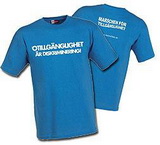 2012-06-13 - nytt erbjudande: Hjälp oss att tömma tröjlagret! Du får nu fem tröjor för priset av fyra, inklusive frakt! (80 kr styck.)
Till sidan för att beställa tröjor